
South Tyrol’s Hidden Wall Climbed at Last
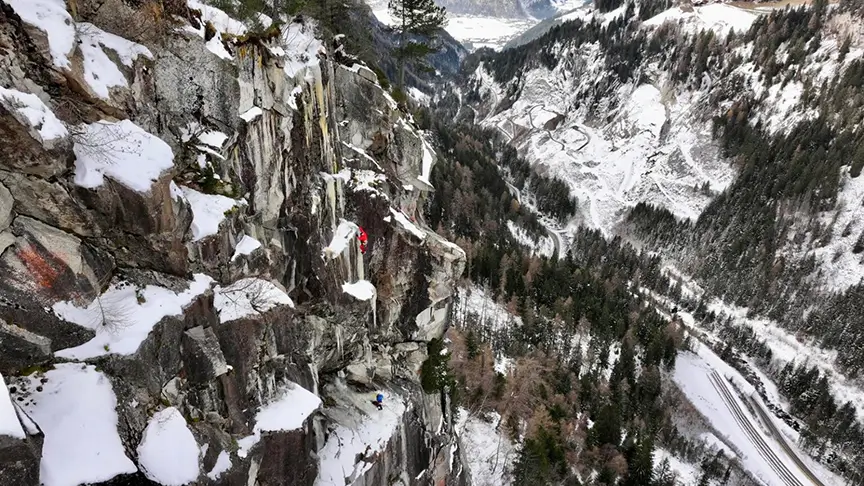
Two climbers in bright jackets on a mixed granite face, Photo: Mario Kaeppeli
Deep in the dramatic landscapes of South Tyrol, two local climbers stumbled on something unexpected this winter: an entire previously unclimbed granite wall, right in their backyard. What made the find remarkable wasn’t just the wall’s untouched nature, but that it lay only 30 minutes on foot from the road – hidden for years by a stand of trees until a recent rockfall exposed it.
For ice and mixed climbers Simon Gietl and Manuel Oberarzbacher, the discovery was irresistible. Both are well known in South Tyrol for seeking out fresh lines on mixed terrain that hundreds of climbers visit each season. Yet even they didn’t expect to uncover a real virgin wall so close to the main routes.
A Wall Hidden by Trees – Now Revealed
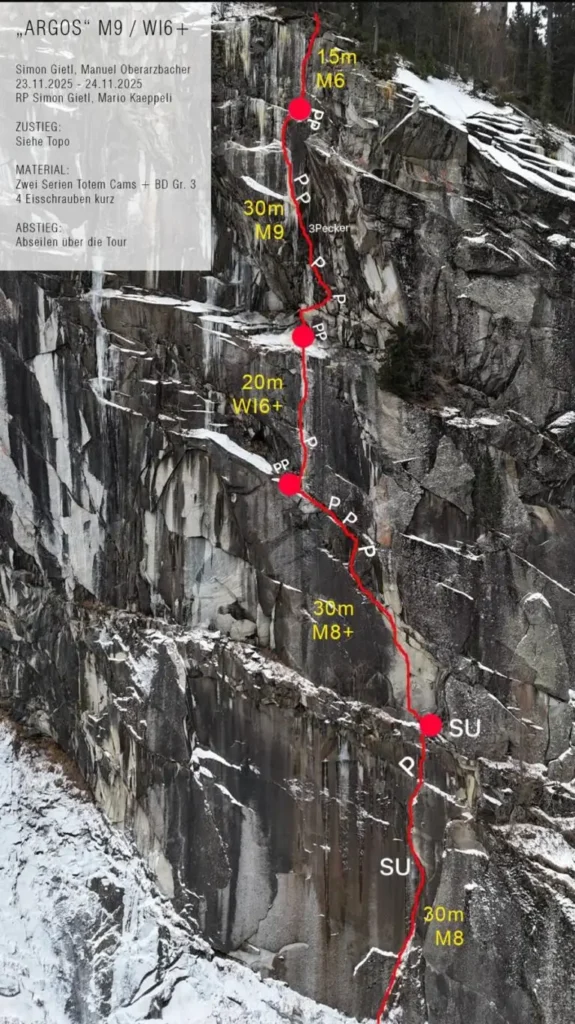
Before the rockslide, the granite face had been completely shielded by a thick grove of trees. Those trees kept climbers from even knowing the wall existed – and its mossy, wet condition ruled out summer rock climbing. But for winter and mixed conditions, the cracked granite slabs proved ideal. On November 23-24, Gietl and Oberarzbacher pushed up the first mixed line on the face, marking the first ascent in recorded climbing history. Just days later, Gietl returned with climber Mario Kaeppeli to redpoint the route climbing it clean after rehearsing it on lead. They named the new line “Argos” and gave it a M9, WI6+ grade, indicating sustained technical difficulty and a demanding combination of mixed and water ice climbing. Argos offers “varied and concentrated climbing” in a surprisingly secluded cliff band despite its proximity to civilization.
Approach and Climbing Details
Though near the road, reaching the route isn’t simple. The approach includes climbing two short mixed pitches rated M4 and M5+ just to reach the base of the main face. From there, the route climbs through five hard pitches of solid granite – cracks, dihedrals and a thin ribbon of ice that defines the crux middle section at WI6+.
The team left fixed gear on the climb for future parties to use:
- Six pitons
- Nine intermediate pitons
- Three pecker pitons
They suggest that anyone looking to repeat Argos should bring gear including two sets of Totem Cams, a set of #3 Friends, and four short ice screws for protection. The descent requires a rappel from the top.
For climbers drawn to new lines and hidden walls, Argos is an exciting find – a fresh mixed climb with character, challenge, and history, right in the heart of the Alps.
Source: Explorersweb

Share this post:



Comments