
Latok I 1978: The Greatest Climb That Failed
In the summer of 1978, four American climbers stood beneath one of the most intimidating lines in the Karakoram – the North Ridge of Latok I.
It was not the tallest peak in Pakistan. Not the most famous. Not even an 8,000-meter giant.
But in the language of alpinism, it was something else entirely:
a masterpiece of difficulty.
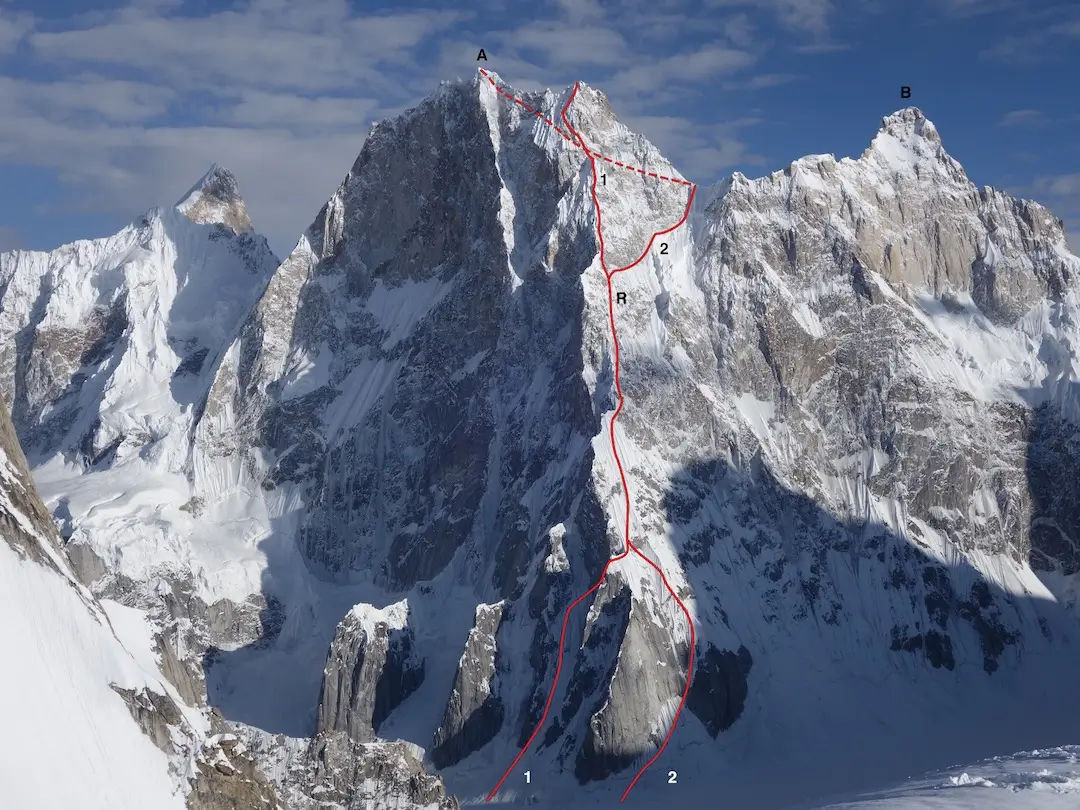
(A) Latok I (7,145 meters) from the north. (B) Latok II. Photo: by Sergey Glazunov
The Ridge That Haunted Alpinists
Rising above the Biafo Glacier in the Karakoram, Latok I is a 7,145-meter granite pyramid. Its North Ridge is not simply steep – it is continuous. Nearly 2,500 vertical meters of technical rock and ice, corniced knife-edges, and exposed traverses. There is almost no place to hide. No easy escape.
In the 1970s, climbers began to see it as one of the last great unclimbed problems in the world – not because of altitude, but because of sustained technical severity at extreme height.
It was the kind of objective that defined reputations.
Four Americans, Alpine Style
The team that arrived in 1978 was not a large expedition. There were no fixed ropes stretching endlessly upward, no siege tactics, no national agenda. The climbers were:
Jeff Lowe – visionary, bold, technically brilliant
Jim Donini – disciplined, analytical, steady
Michael Kennedy – strong, thoughtful
George Lowe – experienced and quietly
They chose to attempt the ridge in alpine style – carrying everything with them, climbing as a single push, committing fully to the line. In 1978, this approach on a Himalayan-scale ridge was still radical. They were not just trying to reach the summit.
They were trying to climb it beautifully.
Climbing Into Exposure
From the first days on the ridge, it was clear that Latok I would not offer anything easily.
The lower sections involved steep granite, requiring delicate free climbing with heavy packs at altitude. Higher up, mixed terrain demanded ice tools and absolute concentration. The ridge narrowed into a serrated spine – thousands of meters dropping away on both sides.
They climbed in rhythm.
They bivouacked on tiny ledges.
They rationed fuel.
They studied weather patterns.
And slowly, they advanced.
Unlike many failed Himalayan attempts that collapse early, this one did not falter. Week after week, they continued solving the ridge’s puzzles.
By the time they reached roughly 6,900-7,000 meters, they had already achieved what many believed impossible: they had climbed nearly the entire North Ridge.
Above them remained only the final headwall – steep, technical, and daunting.
The summit felt close enough to imagine.
The Karakoram Decides
Then the storm came.
The Karakoram does not send polite warnings. It engulfs. Wind screamed along the ridge. Snow loaded the slopes. Visibility vanished.
For days, they endured it – cramped in exposed bivouacs, conserving strength, hoping for a break. Food was limited. Fuel nearly gone. Every extra hour at that altitude drained reserves.
They debated.
Push upward and risk being trapped above the crux with no way down?
Or retreat from the greatest climb of their lives?
The mythology of mountaineering often celebrates those who ignore doubt.
But experience teaches something else:
the mountain does not care about your dream.
The storm did not lift.
And so, with the summit painfully close, they made the decision few talk about, but every serious climber respects:
They turned around.
The Long Way Down
Retreating the North Ridge was not a simple reversal. It was a full second ascent – downward.
They rappelled through unstable snow. Re-climbed sections to find anchors. Negotiated overhanging cornices. Managed exhaustion at altitude.
One mistake would have sent them thousands of meters down either side.
But they moved carefully, deliberately – and they survived.
No summit photo.
No triumphant return.
No headline of “first ascent.”
Only something quieter:
A line drawn almost to the top.
Why Latok I 1978 Became Legend
In the decades that followed, many of the world’s strongest climbers attempted the North Ridge. Storms turned them back. Technical barriers halted progress.
For nearly forty years, the ridge remained unclimbed in its full original vision.
It wasn’t until 2018 that Russian climbers completed a variation of the North Ridge to the summit – a monumental achievement in its own right.
But even then, many in the climbing world said the same thing:
The 1978 American attempt was still one of the boldest and most visionary alpine efforts ever made.
Because they proved the ridge was possible –
just not that year.
What Makes a Climb Great?
Latok I 1978 challenges how we define success.
They did not stand on the summit.
They did not claim a first ascent.
Yet their climb is still studied, admired, and spoken of with respect bordering on reverence.
Why?
Because they climbed with imagination.
Because they committed fully.
Because they retreated when judgment demanded it.
And because sometimes, the most meaningful achievements in the mountains are the ones that end just short of glory.
In Summit Chronicles, Latok I is not a story of failure.
It is a story about knowing when enough is enough –
even when the summit is within reach.

Share this post:



Comments