
Cerro Torre 1959: The Summit No One Saw
At the southern edge of Patagonia, where the Andes shatter into ice and wind, rises one of the most improbable shapes in mountaineering: Cerro Torre.
It is not tall by Himalayan standards – just over 3,100 meters – but height is irrelevant here. Cerro Torre is vertical granite polished by storms, capped with a grotesque mushroom of rime ice that can double the difficulty of the final meters. The wind never seems to stop. Weather systems arrive without warning and linger for days.
In the 1950s, many climbers considered it unclimbable.
Then, in 1959, an Italian named Cesare Maestri announced that he and his partner had stood on its summit.
Only one of them came back.
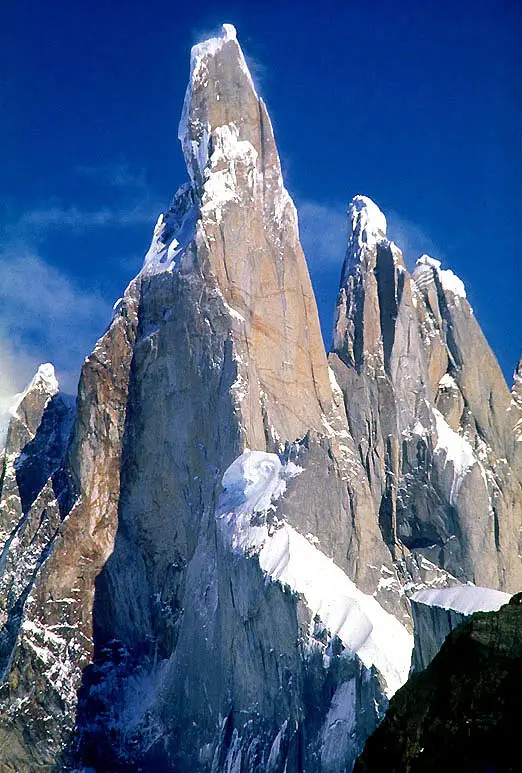
Cerro Torre, Photo: Wikipedia
The Climb and the Avalanche
Maestri arrived in Patagonia with Austrian climber Toni Egger, a young and exceptionally strong alpinist. The two set their sights on the northeast face – a blank sweep of granite that appeared to offer almost no weakness.
In January 1959, they disappeared onto the wall.
When Maestri returned days later, he was alone.
He told a story of success followed by catastrophe. According to his account, they had reached the summit on January 31 after days of extreme climbing. On the descent, an avalanche struck. Egger was swept away and killed. The camera containing summit photographs – the only physical proof – was lost with him.
Maestri survived, battered and grieving.
The world accepted the ascent. A tragedy had taken one climber; few pressed hard for evidence.
But mountains, like memories, do not remain unquestioned forever.
The First Doubts
As the years passed and climbers returned to Patagonia, Cerro Torre’s reputation only grew. Its walls were studied more closely. Attempts were made. Failures mounted.
Something began to trouble experienced alpinists.
The terrain Maestri described did not seem to match the reality of the upper mountain. Climbers who reached high on the peak found no trace of pitons or anchors where Maestri claimed to have climbed. Technical sections he described appeared far more severe than what 1959 equipment and methods would likely have allowed.
In 1975, an Italian team led by Casimiro Ferrari completed what became the first widely accepted ascent of Cerro Torre, via the west face. They found no convincing evidence of a prior passage on the summit headwall.
The whispers became open skepticism.
Did Maestri truly stand on top?
Or had ambition, trauma, and the chaos of survival blurred the truth?
The Return With a Machine
In 1970, before the Ferrari ascent, Maestri had already returned to Cerro Torre – this time determined to silence doubt.
He brought something no one had ever seen on such a mountain: a gasoline-powered air compressor. With it, he drilled expansion bolts directly into the granite, methodically forcing a line up the southeast ridge. Hundreds of bolts scarred the rock.
The route – later called the Compressor Route – stopped short of the final ice mushroom. Maestri argued that the mushroom was ephemeral, not part of the true summit.
Many in the climbing world were stunned. Some saw defiance. Others saw proof that the original ascent had been impossible without such artificial means.
Instead of settling the debate, the compressor only deepened it.
Maestri never wavered. Until his death in 2021, he maintained that the 1959 summit was real.
An Argument That Refuses to End
Decades later, modern climbers – equipped with lighter gear and advanced techniques – confirmed that Cerro Torre is climbable. But they also demonstrated how extraordinarily difficult the upper headwall truly is.
In 2012, climbers removed many of the Compressor Route bolts, arguing that the mountain deserved restoration. Even that act reignited controversy.
Cerro Torre had become more than a spire of granite. It had become a symbol.
Mountaineering operates largely on trust. Climbs often occur far from witnesses. Proof can be minimal. Integrity is the currency of the craft.
When one climber dies and the only surviving witness tells the story, how do we measure truth?
There is no recovered camera.
No photograph.
No physical trace beyond a disputed narrative.
And yet there is no definitive disproof either.
The Mountain Keeps Its Silence
Today, Cerro Torre still rises above the Patagonian icefields, wind tearing across its summit mushroom. It does not confirm. It does not deny.
Perhaps that is why this story endures more than sixty years later.
Because it forces a deeper question than whether a summit was reached.
It asks whether memory can be trusted under trauma.
It asks whether the desire to conquer can reshape reality.
Some mountains test strength.
Cerro Torre tested belief.
And the summit of 1959 remains the one no one saw.

Share this post:



Comments