
They Reached the Summit – But It Nearly Destroyed Them
By 1970, Annapurna was already feared. Its summit had been reached in 1950, but its reputation had only grown darker with time. Avalanches, unstable slopes, and high fatality rates made it one of the most dangerous peaks in the Himalaya.
Yet one feature remained untouched – avoided, even by the strongest climbers in the world.
The South Face.
It rose like a frozen ocean wave: 3,000 meters of steep rock, ice, and hanging seracs. From below, it looked less like a route and more like a barrier. A place where mistakes wouldn’t just cost success – they would cost lives.
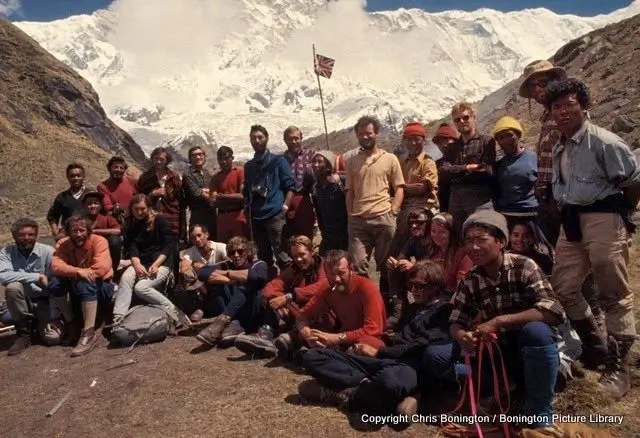
In 1970, a British expedition led by Chris Bonington decided to try anyway.
Climbing Into the Unknown
Bonington’s team was among the strongest of its era, including climbers like Don Whillans, Dougal Haston, and Ian Clough.
They approached the South Face not as a single push, but as a prolonged battle. This was not alpine style – it was a siege against one of the most complex walls in the Himalaya.
They fixed ropes across dangerous sections. Established camps on precarious ledges. Carried loads again and again through terrain that felt constantly on the verge of collapse.
Above them, seracs loomed – massive blocks of ice that could fall without warning.
Below them, the face dropped thousands of meters.
Progress was slow, exhausting, and psychologically draining.
The Cost Begins to Show
The mountain did not wait for them to make mistakes.
During the expedition, tragedy struck. Ian Clough was killed by a falling serac while descending after helping establish higher camps. It was a brutal reminder that on Annapurna, even retreat could be fatal.
The team continued.
Higher on the face, conditions worsened. Exhaustion set in. Frostbite began to take its toll. Every movement required focus. Every decision carried weight.
But they kept going.
The Summit Push
In May 1970, after weeks on the face, the final push began.
Dougal Haston and Don Whillans moved toward the summit through steep, technical terrain at extreme altitude. The air was thin, the weather unstable, and their bodies already pushed beyond normal limits.
When they finally reached the summit of Annapurna, it was a historic achievement – the first ascent of the South Face, one of the greatest climbing feats of the era.
But there was no sense of triumph.
Only exhaustion.
Survival, Not Victory
The descent was as dangerous as the climb.
Haston and Whillans were forced into an open bivouac high on the mountain, without proper shelter, in extreme cold. Survival itself became uncertain.
Frostbite worsened. Strength faded. The line between success and disaster blurred completely.
They made it down – but not unchanged.
Several members of the expedition suffered severe frostbite. Physical damage would last a lifetime. The psychological impact lingered even longer.
This was not a clean victory.
A Different Kind of Success
The 1970 South Face ascent of Annapurna is often described as one of the greatest climbs in mountaineering history.
But it is also one of the clearest examples of a deeper truth:
Reaching the summit does not always mean winning.
The expedition succeeded in technical terms. They climbed one of the hardest walls on Earth. They achieved what many thought impossible.
But the cost – death, injury, trauma – forced a different kind of reflection.
What is success, if it leaves everything else behind?
The Legacy of the South Face
Today, the South Face of Annapurna remains one of the most serious objectives in high-altitude climbing. It has been repeated only a handful of times, each ascent carrying the weight of history.
The 1970 expedition did more than open a route. It redefined what was possible – and what it might cost.
In Summit Chronicles, this story stands apart.
Not because of the summit.
But because of what it revealed after it was reached.

Share this post:



Comments