
First Ski Descent of Jones Route on Mt Cook
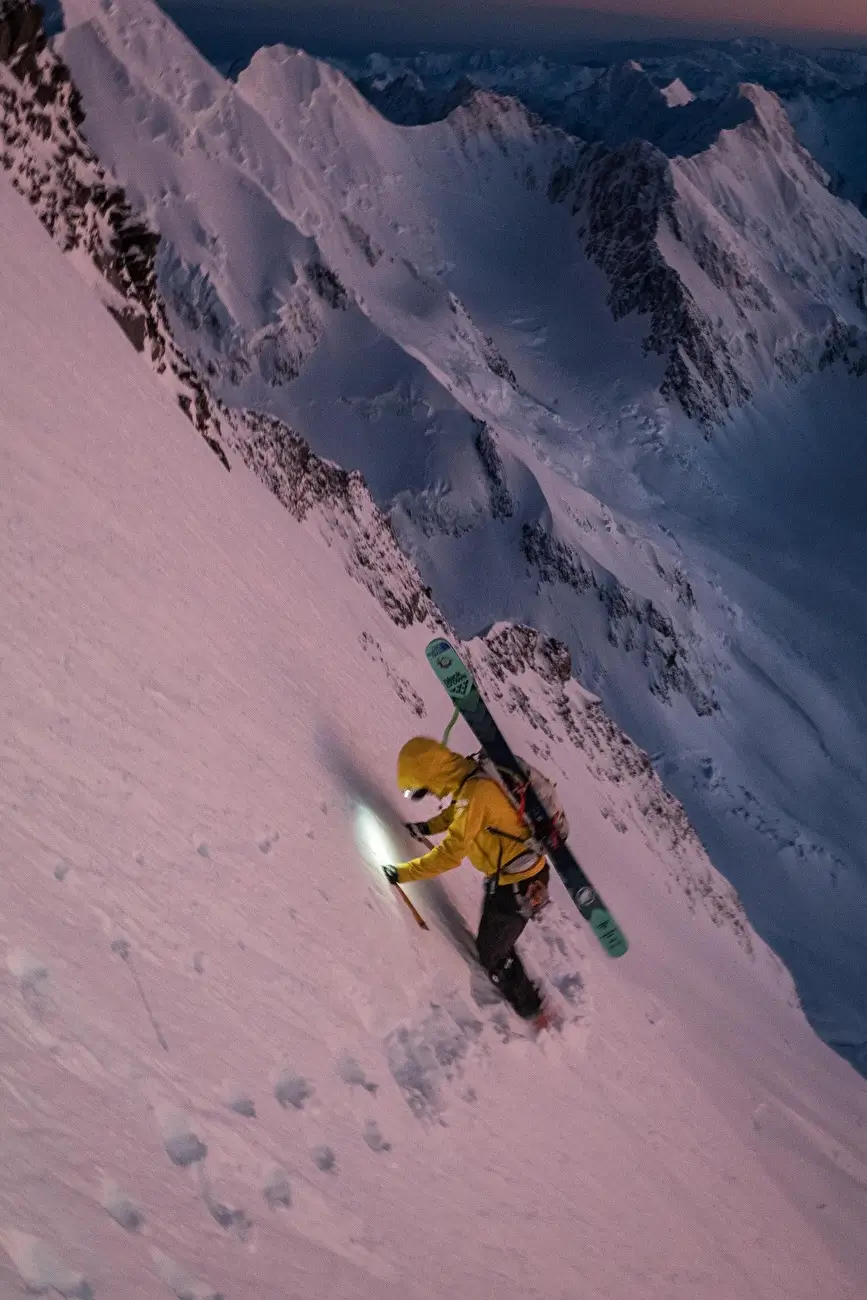
Photo: Sam Smoothy
On November 1, 2025, British ski mountaineer Ross Hewitt, together with Will Rowntree and Sam Smoothy, completed the first-ever ski descent of the Jones Route on the East Face of Aoraki / Mt Cook (3,724 m) – New Zealand’s highest peak. The 1,000-metre line, graded 5.5 E4, is one of the most demanding faces in the Southern Alps and is rarely climbed, let alone skied.
The Jones Route cuts through the centre of Mt Cook’s vast East Face. Defined by a dramatic series of snow spines and steep couloirs, it begins with a 500-metre spine leading up to the rocky headwall. From there, the route traces an exposed ramp that traverses left over a triple set of spines before twisting right and back left, finishing with two more spines and a narrow exit gully that reaches the summit ridge.
“The route corkscrews across the face – steep, complex, and breathtakingly exposed,” said Hewitt, describing the descent as “a line that grips you from the moment you commit.”
This year’s spring in New Zealand was marked by weeks of relentless storms, making any alpine attempt nearly impossible. On October 23, the rain gauge at Mt Cook Village recorded 487.5 mm of rain in just seven days, while winds reached 250 km/h at only 2,000 metres.
Hewitt and his partners had failed on the same line the previous year, forced back by 120 km/h gusts. Returning this season, they faced the mountain with “massive trepidation for the wind.”
Setting off from Plateau Hut at 1 a.m., the trio climbed into the cold shadow of Aoraki’s East Face. They crossed the bergschrund around 2 a.m. and transitioned to crampons, quickly gaining 500 metres to the headwall. From there, the terrain steepened dramatically.
“Everything gets more exposed above the headwall,” Hewitt recalled. “We removed the plates and climbed unroped through deep snow and sections of black ice.”
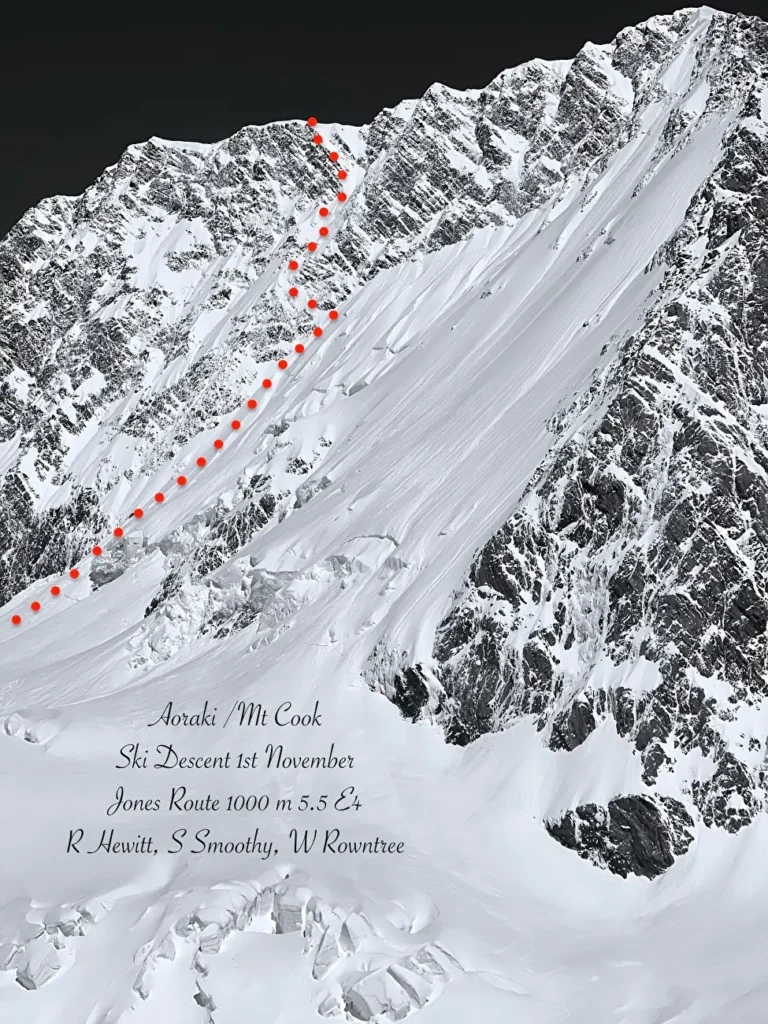
Photo: Ross Hewitt
By dawn, they reached the exit gully. Finding black ice, they pre-rigged for an abseil during descent, then wallowed through exhausting knee- to thigh-deep snow until they reached the summit ridge – just as the first light hit the Tasman Glacier.
With the face coated in fresh powder, the team transitioned quickly to skis to stay ahead of the warming snow.
“It felt so good to move from the insecurity of crampons in powder to skis,” Hewitt said. “The anxiety of the climb faded as excitement started to build.”
The first turns were tentative, but confidence grew as they descended. The team skied steep 50° spines and even steeper sections, linking precise turns down the face’s complex terrain. “The triple spine feature on the ramp was heart-in-your-mouth stuff,” Hewitt admitted. “But when we reached the final 500m spine, we could finally breathe and relax a little – from hyper-stimulated to just over-stimulated!”
At the base of the face, adrenaline gave way to deep fatigue. The short skin back to Plateau Hut felt endless.
“It’s hard to imagine better snow conditions shared with these guys on a rare windless day,” Hewitt said. “Altogether, it was the perfect day.”
For Hewitt, Rowntree, and Smoothy, this marked not just a first descent – but a rare moment of stillness and precision on one of New Zealand’s most formidable walls.
The Jones Route, named after early New Zealand alpinist Phil Jones, is one of the most technical and least-traveled lines on Aoraki’s East Face. The face itself is notorious for its steepness, exposure, and avalanche risk, with only a handful of successful ascents each decade.
The trio’s first ski descent adds a historic milestone to New Zealand’s mountaineering legacy -merging technical climbing history with modern ski mountaineering mastery.
Source: Ross Hewitt (rosshewittguiding.com)

Share this post:



Comments