
New Mixed Route Opened in the Bernese Oberland
British climber Fay Manners and Austrian climber Melanie Grünwald have completed the first ascent of a new mixed climb, Elles Aussi, in Switzerland’s Bernese Oberland.
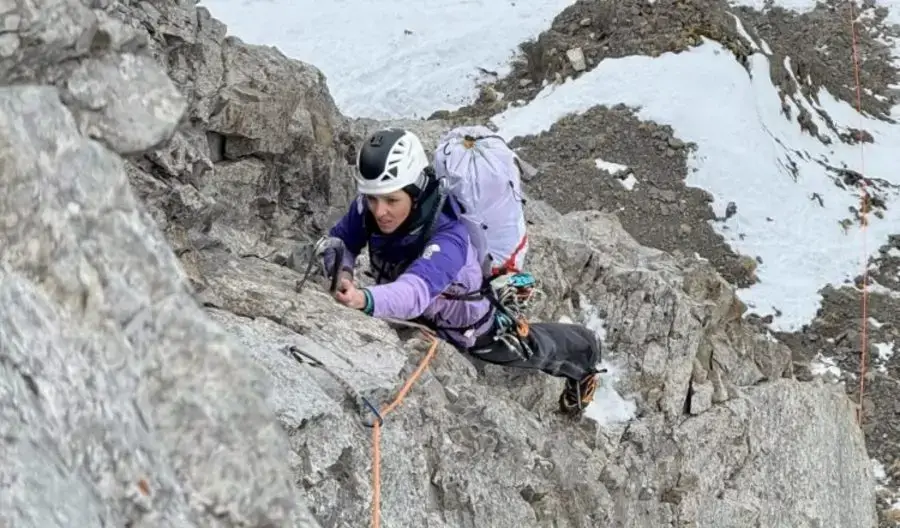
Melanie Grunwald. Photo: Gripped Magazine
The route rises 135 metres and is graded M7+ A0. The pair established the line over several days in January, adding a demanding winter route to the Bernese Oberland’s mixed-climbing landscape.
In a series of reflections shared after the ascent, Manners explained that searching for a mixed line is fundamentally different from finding a summer rock route. Rather than looking for perfect stone, she focuses on how winter conditions might transform a wall.
She described mixed terrain as often broken, dirty, or fractured, which is precisely why it becomes climbable with ice tools rather than hands. What matters, she explained, is the wall’s potential: where snow might settle into cracks, where ice could form after storms, and which sections are unlikely to remain dry through the winter.
Thin cracks that would be useless for finger climbing can become ideal placements for torquing ice axes, while blocks unstable in summer may freeze solid and serve as reliable hooks in winter. For Manners, a winter line is not only what is visible, but what cold, snow, and ice might turn it into.
Manners emphasized that in mixed climbing, cold is not an added hardship but a core element of the climb itself. Long belays, limited movement, and constant exposure demand careful planning and efficiency.
She described the need to manage warmth with precision: climbing in gloves, handling ropes with numb fingers, and staying constantly aware of heat loss. Spindrift frequently pours down the face, filling clothing, helmets, and cracks, reinforcing the need to keep moving and stay organized.
Her approach involves deliberate layering, spare gloves and insulation, and rapid transitions at belays. Food, she noted, is as important as clothing, since energy intake directly supports warmth and function.
Learning to manage the cold, Manners said, is inseparable from learning winter climbing itself.
Mixed climbing, she explained, relies on precision rather than power. Monopoints balance on tiny edges, and ice axes may be used alternately for hooking, balance, or subtle body positioning. Abrupt movements can instantly compromise a placement, making control and tension essential.
Manners acknowledged that certainty in placements is often elusive. Instead, trust develops through physical feedback – pressure, stillness, and balance – and through experience. Committing to moves without absolute certainty is part of what defines the discipline.
Manners also highlighted dry tooling as an important form of preparation for mixed climbing. She prefers routes that use natural features rather than drilled holds, as they teach climbers how real placements behave and how small adjustments affect stability.
At the same time, she noted that drilled dry-tooling routes have their place, particularly for building strength, refining movement, and developing precision. Both dry tooling and mixed climbing, she emphasized, demand patience, repetition, and focus – much like hard rock climbing.
With Elles Aussi, Manners and Grünwald add a thoughtful, demanding new winter line to the Bernese Oberland, shaped not only by rock, but by the possibilities that winter itself creates.
Source: Gripped Magazine

Share this post:



Comments