
Peak Pobeda 1955: Frozen on the Ridge of Victory
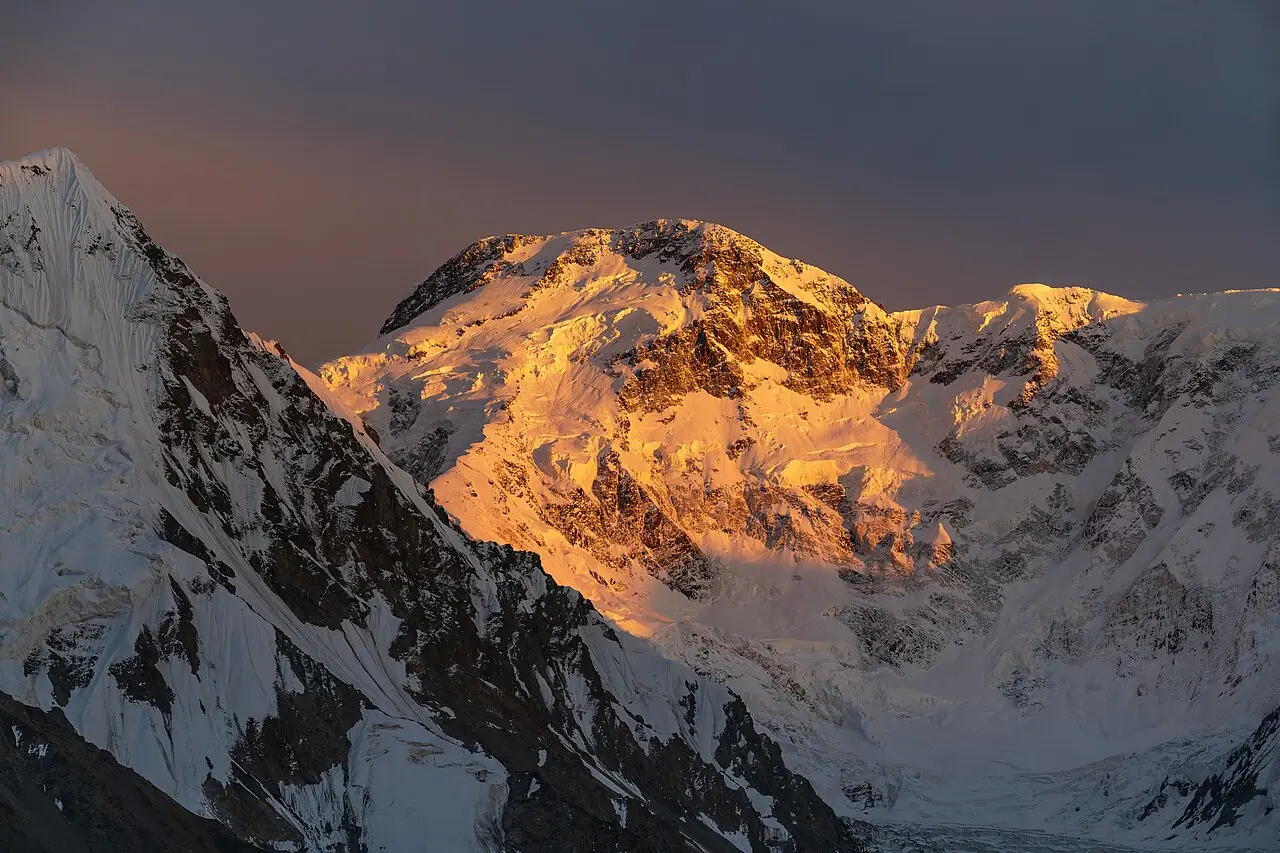
Jengish Chokusu (Victory Peak, Pik Pobeda), Photo: Wikipedia
A Mountain Named for Triumph
In the eastern Tian Shan, where Kyrgyzstan meets China, rises a vast, wind-lashed massif once known as Peak Pobeda – “Victory Peak.” Today it is called Jengish Chokusu, 7,439 meters high and widely regarded as the hardest and coldest 7,000-meter peak on Earth.
In the 1950s, Soviet mountaineering was both sport and statement. High summits in Central Asia were stages on which strength, discipline, and collective will were meant to triumph. Pobeda – remote, severe, and politically resonant – was a crown to be claimed.
It would instead become a tomb.
The 1955 Push
The 1955 Soviet expedition assembled strong climbers, veterans of the Caucasus and Pamirs, hardened by cold and long traverses. Pobeda’s North Ridge is no simple line: a complex chain of corniced crests and steep snowfields exposed to relentless wind. Weather systems build fast in the Tien Shan; temperatures can plunge below – 40°C; storms can last for days.
The team moved steadily upward, fixing camps along the ridge. Progress was demanding but controlled. Forecasting was rudimentary; communication limited. Like many expeditions of the era, they relied on experience and instinct more than data.
Then the storm arrived.
When the Ridge Became a Trap
It did not come as a gentle deterioration. Winds intensified, spindrift avalanches swept the crest, visibility collapsed. On a ridge that offers almost no shelter, the team found themselves pinned high above retreat options. Cornices – those overhanging lips of wind-sculpted snow – became lethal obstacles. Every step risked a break through to the void.
As hours turned to days, movement slowed. Frostbite set in. The cold did not ebb at night; it deepened. On Pobeda, storms do not simply pass – they grind.
Attempts to descend were thwarted by whiteout and unstable slopes. Turning around on such terrain is often more dangerous than continuing; on Pobeda, either choice can be fatal. The ridge became a corridor of exposure with no safe haven.
The team was trapped in the open.
Silence on the Mountain
In Soviet mountaineering culture of the time, heroism was collective; failure was often muted. Details of the 1955 catastrophe were sparse and filtered through official channels. What is clear is this: the storm did not break in time.
When later search efforts reached the upper ridge, they found the climbers as they had faced the storm -still roped together. The rope that binds a team for safety had become a final link in their last stand. Exposure and exhaustion had claimed them where they fought to hold position.
It was one of the coldest images in mountaineering history.
Why Pobeda Is Different
Unlike Himalayan giants whose fame is global, Pobeda’s terror is intimate and geographic. It is not the tallest; it is among the most unforgiving. Its length, remoteness, and volatile weather have earned it a reputation that seasoned alpinists speak of in lowered tones.
Even today, experienced climbers consider Pobeda more serious than many 8,000ers. Long ridges, scarce rescue possibilities, and extreme continental cold make it a mountain where small errors compound quickly – and storms dictate the terms.
The 1955 disaster did not involve oxygen controversies, summit disputes, or political rivalries. It was simpler and harsher: a team overtaken by a mountain’s weather, immobilized on an exposed spine of ice.
Victory, Reconsidered
“Victory Peak” was meant to symbolize triumph. In 1955, it revealed something else: that no ideology, no preparation, no collective resolve can negotiate with a Tien Shan storm.
The climbers did what mountaineers have always done – advanced when they could, held ground when they must, trusted the rope between them. The mountain answered with wind and cold beyond endurance.
Peak Pobeda remains a test not of ambition but of judgment. Its ridge still stands, corniced and wind-scoured, a reminder that in some places the margin between summit and survival is measured in hours of weather.
In Summit Chronicles, the 1955 Pobeda catastrophe is not a story of conquest. It is a story of exposure – of how thin the line can be when the storm decides not to pass.
A dramatic mountain peak glows with intense golden-orange alpenglow during sunset or sunrise. The central summit, heavily snow-covered, catches warm sunlight on its rugged face and ridges, while surrounding peaks and deep valleys remain in cool blue shadows. The sky above transitions from deep twilight to soft orange near the horizon, highlighting the massive scale and icy texture of the high-altitude landscape.
A dramatic mountain peak glows with intense golden-orange alpenglow during sunset or sunrise. The central summit, heavily snow-covered, catches warm sunlight on its rugged face and ridges, while surrounding peaks and deep valleys remain in cool blue shadows. The sky above transitions from deep twilight to soft orange near the horizon, highlighting the massive scale and icy texture of the high-altitude landscape.

Share this post:



Comments